

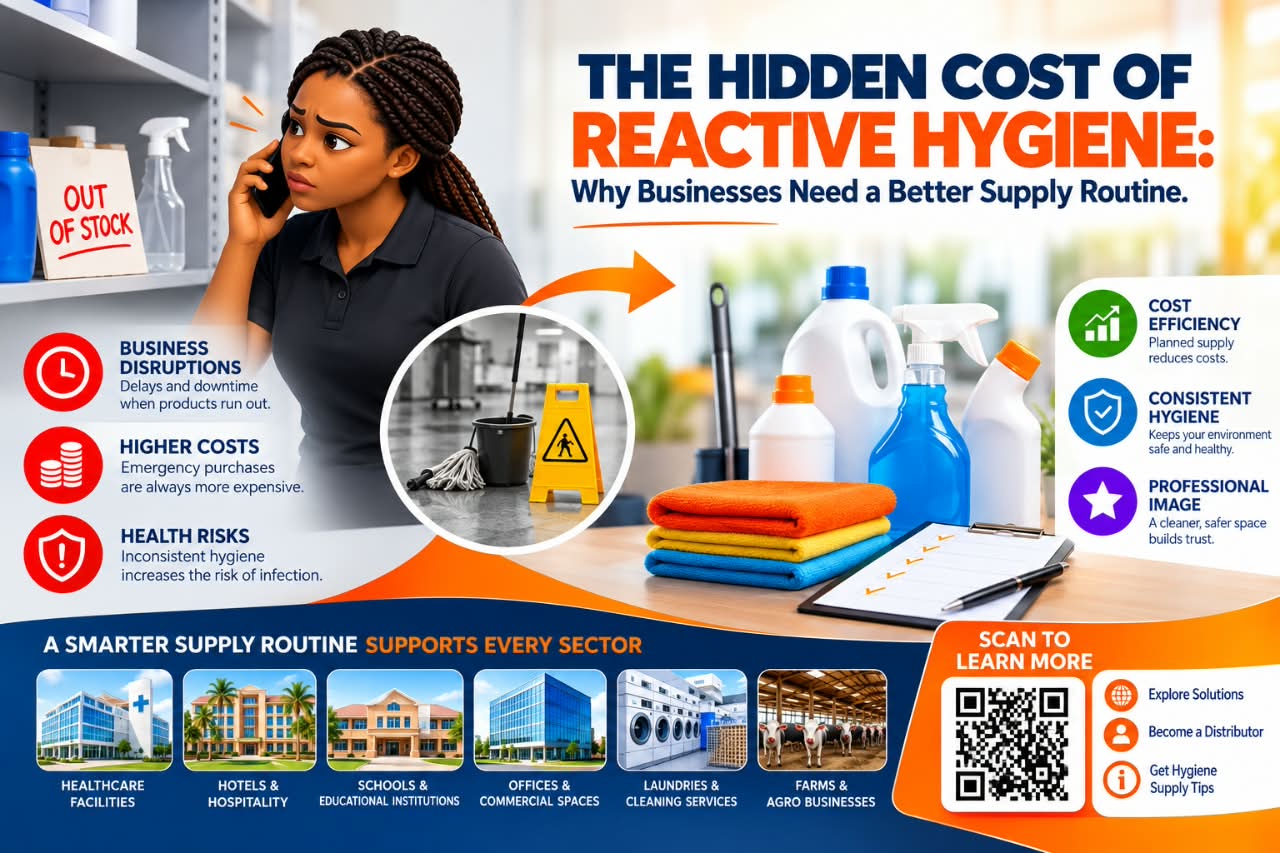
For many businesses, hygiene supplies are easy to overlook—until they run out.
A bottle of disinfectant is empty. Cleaning supplies were not reordered. The facility team needs products urgently. A supplier has to be contacted at the last minute. Staff start looking for alternatives, and suddenly a routine operational requirement becomes an avoidable problem.
This is the hidden cost of reactive hygiene supply management.
While businesses often focus on major expenses such as rent, salaries, equipment, utilities and logistics, the cost of poorly managed hygiene supplies can also affect daily operations. When organisations wait until products are almost finished before planning their next order, they may face unnecessary pressure, inconsistent purchasing and difficulty maintaining a reliable cleaning routine.
For offices, schools, hospitals, hotels, event centres, factories, retailers and other organisations, a better approach is to treat hygiene supplies as part of routine operational planning rather than something to think about only when stock runs out.
What Is Reactive Hygiene Supply Management?
Reactive hygiene management means responding to problems as they occur instead of planning ahead.
For example, an organisation may only reorder cleaning products when someone notices that the supply cupboard is almost empty. Another business may purchase products only after a particular cleaning task suddenly becomes urgent.
At first, this may seem like a minor issue. However, when the same pattern happens repeatedly, it can create operational inefficiencies.
A reactive approach often looks like this:
Product runs low → someone notices → urgent request is made → supplier is contacted → product is sourced → staff wait or improvise → normal routine resumes.
A planned approach looks different:
Usage is monitored → stock levels are reviewed → requirements are forecast → supplies are reordered → products are available when needed.
The difference is not simply about buying more products.
It is about creating a better hygiene supply routine.
Why Hygiene Supplies Deserve More Attention
Hygiene products are part of the everyday running of many organisations.
An office may need products for routine cleaning. A school may have multiple shared spaces requiring regular attention. A hotel has rooms and common areas to manage. A hospital or healthcare facility has specific hygiene requirements. A factory may have production and non-production areas that need cleaning. Event centres may experience changing requirements depending on bookings and foot traffic.
Therefore, hygiene supply management should not be treated as an afterthought.
When products are needed regularly, organisations need to know three things:
- What products are required?
- How frequently are they used?
- When should they be reordered?
Once these questions are answered, purchasing becomes more structured.
Moreover, organisations can begin identifying patterns instead of repeatedly reacting to shortages.
For healthcare organisations in particular, environmental cleaning is an important part of facility management. The World Health Organization provides guidance and training resources on environmental cleaning and infection prevention and control in healthcare facilities.
The Hidden Costs of Waiting Until Supplies Run Out
The most obvious problem with reactive purchasing is the possibility of running out of a product when it is needed.
However, the consequences can go beyond an empty shelf.
1. Last-Minute Purchasing Creates Pressure
When a product is needed immediately, the purchasing process can become unnecessarily rushed.
Instead of comparing requirements, checking existing stock and planning an order, staff may simply focus on finding something available quickly.
As a result, procurement decisions can become driven by urgency rather than planning.
A structured supply routine gives organisations more time to review what they actually need and communicate those requirements clearly to suppliers.
2. Stockouts Can Disrupt Routine Operations
Cleaning and hygiene activities are often recurring tasks.
Therefore, when an organisation unexpectedly runs short of an important supply, the issue can affect more than the person responsible for purchasing. It may create additional work for facility teams, administrators, storekeepers or procurement staff.
In larger organisations, the impact can extend across departments.
The objective should not be to keep excessive stock. Instead, the objective is to maintain an appropriate supply routine based on actual usage and operational requirements.
For businesses and community facilities, the CDC also recommends regular cleaning of high-touch surfaces and provides guidance on when facilities should be cleaned and disinfected.
3. Emergency Buying Can Make Procurement Less Efficient
Planned procurement allows organisations to consolidate requirements and communicate them properly.
By contrast, repeated urgent purchases can create fragmented ordering.
For example, instead of reviewing several requirements together, an organisation may place multiple smaller orders because different products run out at different times.
Over time, that can make procurement more difficult to manage.
A better system starts with visibility.
Know what is being used, know what is available and know when the next order should be considered.
4. Poor Planning Can Make Budgeting More Difficult
Hygiene supplies are recurring operational expenses.
Consequently, organisations can benefit from understanding their purchasing patterns over time.
If a business knows approximately how much of a particular product it uses within a given period, it can begin planning its procurement more effectively.
This does not mean assuming that usage will always remain the same.
Instead, businesses should consider factors such as:
- Number of employees or users
- Number of facilities or locations
- Frequency of cleaning
- Seasonal activity
- Events and special programmes
- Changes in occupancy
- Expansion or reduction in operations
- Historical purchasing patterns
With this information, hygiene supply planning becomes more informed.
A Better Hygiene Supply Routine Starts With Visibility
The first step towards better hygiene procurement is knowing what is actually happening.
Before changing suppliers or increasing purchasing volumes, organisations should examine their current routine.
Ask simple questions:
Which hygiene products do we use most frequently?
Which products run out unexpectedly?
Who monitors stock?
How often is stock reviewed?
How long does it normally take to replenish supplies?
Which locations use the most products?
Are different departments making separate purchases?
These questions can reveal gaps that may otherwise remain unnoticed.
For instance, a company may discover that its head office has a predictable monthly requirement while another branch frequently places emergency orders.
That insight can help the organisation create a more consistent purchasing process.
Build a Simple Hygiene Inventory System
You do not necessarily need complicated software to start.
A simple inventory sheet can provide useful visibility.
For each product, record:
| Information | Example |
|---|---|
| Product | Product name |
| Location | Head office, branch, facility, etc. |
| Current stock | Quantity available |
| Average usage | Estimated monthly or weekly usage |
| Reorder point | Level at which a new order should be considered |
| Last order | Date of previous purchase |
| Supplier | Current supplier |
| Next review | Planned stock review date |
The important thing is consistency.
Once the information is recorded regularly, organisations can begin identifying purchasing patterns.
Furthermore, procurement teams can use this information when communicating with suppliers.
Standardise Your Hygiene Supply Requirements
Another useful step is to create a standard list of regularly required hygiene products.
Instead of every department purchasing independently, organisations can identify the products that are routinely needed across their operations.
Depending on the organisation, this may include products used for:
- General cleaning
- Surface hygiene
- Personal hygiene
- Facility maintenance
- Laundry-related tasks
- Healthcare or institutional environments
- Other approved operational requirements
However, standardisation does not mean that every organisation should use the same product for every task.
Quite the opposite.
Products should be selected according to their intended use, product information and label directions.
The goal is to make the purchasing process clearer, not to eliminate the need for appropriate product selection.
Businesses looking to review available options can explore the Morison product range and review individual product information before making a purchasing decision.
Choose a Supplier That Can Support Your Routine
A reliable hygiene supply strategy also depends on the supplier relationship.
For organisations purchasing hygiene products regularly, the conversation should go beyond asking, “How much does this product cost?”
Businesses should also consider:
- Product suitability for the intended application
- Available product range
- Supply capacity
- Ordering process
- Location and distribution requirements
- Communication
- Product information
- Lead times
- Business support
The right questions will depend on the organisation and its requirements.
For example, a school may have different needs from a hotel. Likewise, a factory may have different requirements from a retailer or healthcare organisation.
Therefore, businesses should communicate their actual operating requirements when discussing supply.
For organisations interested in working with Morison as a distributor or business partner, the Morison distributor page provides a starting point for submitting business details and discussing the appropriate pathway.
Why Local Manufacturing Can Matter to Business Buyers
For Nigerian businesses, sourcing from a local manufacturer can also be part of a broader procurement strategy.
Morison Industries Plc has operated in Nigeria for decades and provides hygiene, healthcare and agro-allied products for different markets.
For business buyers, the conversation is not simply about purchasing a bottle of cleaning product.
It can be about finding a supply partner that understands the local market and can discuss requirements based on the customer’s business type, location and product needs.
Morison’s range includes products across household, institutional, healthcare and other applications. Organisations can review individual product information to determine which products are relevant to their requirements.
For example, businesses interested in everyday cleaning applications can review the Bymo Multi-Purpose Liquid Detergent product information and determine whether it is appropriate for their intended task.
Similarly, organisations considering bleach-related cleaning requirements can review the ChloSpark Multi-Purpose Bleach product page and follow the applicable product directions.
The key is to match the product to the task and follow the applicable product directions.
From One-Off Purchases to a Supply Routine
The biggest change businesses can make is moving from transactional purchasing to planned supply management.
Instead of asking:
“What do we need right now?”
Start asking:
“What will we need over the next few weeks or months?”
That simple shift can change the way procurement teams operate.
A business can review historical usage, identify frequently purchased products, establish stock review dates and communicate upcoming requirements to its supplier.
As a result, the purchasing process becomes more predictable.
Moreover, the organisation has a better opportunity to identify problems before they become urgent.
Five Questions Every Business Should Ask About Its Hygiene Supplies
If your organisation does not currently have a structured hygiene supply routine, start with these five questions:
1. What products do we use regularly?
Create a basic list based on actual purchasing and operational requirements.
2. Which products run out most often?
These products may need closer monitoring.
3. Who is responsible for checking stock?
A clear owner reduces the possibility of everyone assuming someone else is monitoring supplies.
4. How often should stock be reviewed?
The right frequency depends on usage and the size and nature of the organisation.
5. How early should we contact our supplier?
Consider your typical usage, ordering process and replenishment requirements rather than waiting until the last product is finished.
These questions are simple. However, they can help turn an informal process into a more organised one.
Hygiene Supply Planning Is an Operational Issue
It is tempting to think of hygiene products as small purchases that do not deserve strategic attention.
However, when an organisation uses these products every week, month after month, they become part of the operational system.
That means procurement teams, facility managers, administrators and business owners should look at hygiene supplies in the same practical way they approach other recurring business requirements.
The objective is not to buy unnecessarily.
It is to plan better, monitor usage and reduce avoidable last-minute pressure.
Ultimately, effective hygiene supply management is about having the right process behind the products.
Build a Better Routine With Morison
Whether you manage an office, school, hotel, healthcare facility, factory, event centre, retail business or another organisation, your hygiene supply needs deserve a structured approach.
Start by understanding your usage.
Then identify your recurring requirements, review stock consistently and communicate upcoming needs early.
Most importantly, choose products based on their intended application and always follow the applicable product label and instructions.
At Morison Industries Plc, we understand that businesses may require more than individual product purchases. They may need a dependable way to discuss their hygiene-product requirements based on their operations, location and supply needs.
If your organisation is reviewing its hygiene supplies or looking for a business supply conversation, contact Morison Industries Plc with your organisation name, location, business type and product requirements.
A better hygiene routine does not start when the cupboard is empty.
It starts before you run out.
Frequently Asked Questions
What is hygiene supply management?
Hygiene supply management is the process of planning, monitoring and replenishing the hygiene products an organisation needs for its routine operations. It involves understanding usage, reviewing stock and planning purchases based on actual requirements.
Why should businesses avoid reactive hygiene purchasing?
Reactive purchasing can create unnecessary pressure because organisations may only begin sourcing products when supplies are already low. A planned routine provides greater visibility of stock and upcoming requirements.
Which businesses need hygiene supply planning?
Any organisation that regularly uses hygiene products can benefit from a structured supply routine. This can include offices, schools, hospitals, hotels, factories, event centres, retailers and other facilities.
How can a business improve its hygiene supply routine?
Start by listing regularly used products, monitoring stock levels, identifying usage patterns, assigning responsibility for stock checks and reviewing requirements at regular intervals.
How can businesses buy hygiene products from Morison?
Businesses can contact Morison Industries Plc with their organisation details, location and product requirements to discuss the appropriate supply or distribution pathway. Product information is available on the Morison website.