

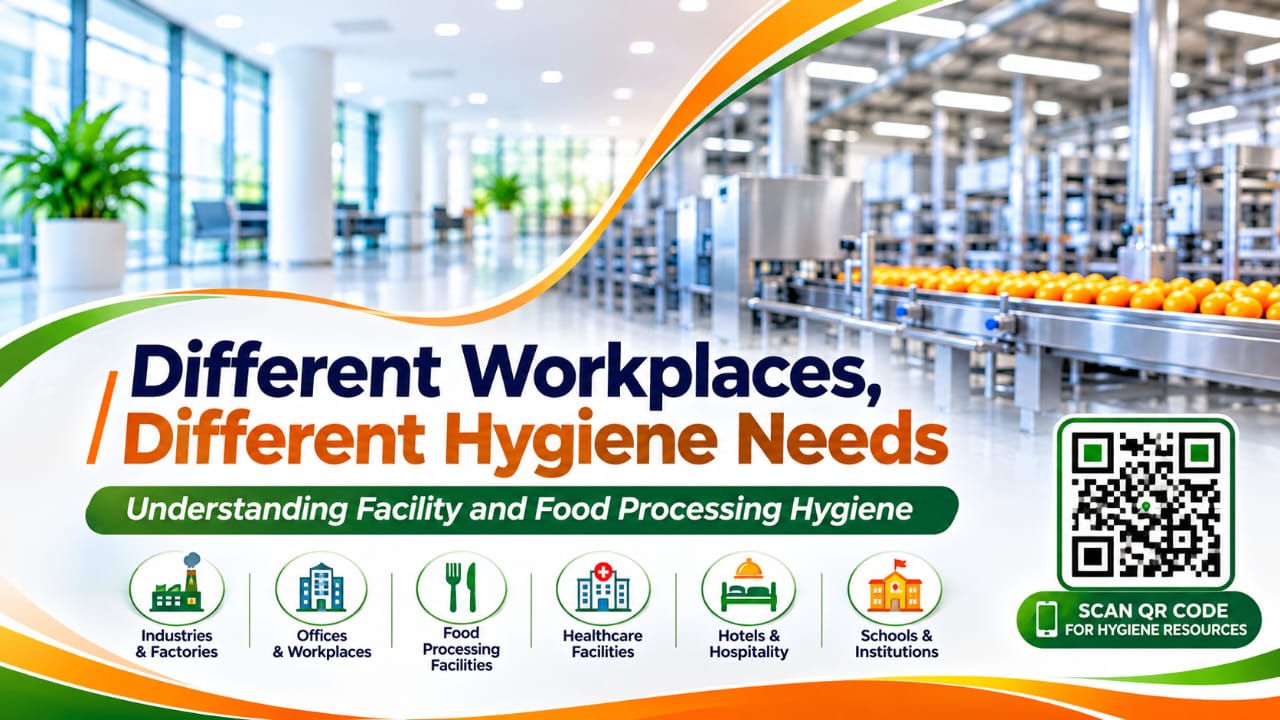
Imagine walking into two different workplaces.
The first is a commercial facility where employees, visitors, and customers move through shared spaces throughout the day. The facility manager must consider the environment’s condition, the cleanliness of frequently used areas, waste management, and unpleasant odours.
The second is a food processing facility. Here, the responsibilities extend beyond keeping the workplace visibly clean. The business must pay close attention to production areas, equipment, food-handling practices, and the hygiene requirements associated with its operations.
Both businesses have one important responsibility in common: maintaining appropriate hygiene standards. However, the products, procedures and considerations involved may differ considerably.
This raises an important question: can the same hygiene approach work for every business environment?
Not necessarily.
Different workplaces have different operational requirements. Understanding these differences is an important first step towards making informed decisions about cleaning, disinfection and other hygiene practices.
Why Hygiene Means More Than Keeping a Workplace Clean
When people think about workplace hygiene, they often focus on what they can see: clean floors, organised workspaces, tidy surroundings and properly maintained facilities.
While these are important, effective hygiene management involves more than appearance.
Businesses also need to consider how shared spaces are maintained, how waste is handled, what cleaning procedures are followed and whether appropriate disinfection practices are in place.
It is also important to understand that cleaning, disinfection and deodorising are not interchangeable terms.
Cleaning involves removing dirt, residues and other unwanted materials from surfaces or objects.
Disinfection refers to the use of appropriate methods or products intended to address microorganisms on specified surfaces or in specified environments.
Deodorising focuses on addressing unpleasant odours.
Although these activities may form part of a wider hygiene programme, each has a different purpose. Therefore, businesses should understand what a particular product is designed to do before selecting it for an application.
Commercial and Institutional Facilities: Managing Everyday Hygiene Needs
Consider the first workplace again.
A commercial building, office, school, hotel, or other institutional facility may accommodate different groups of people throughout the day. Employees use common areas, visitors move between rooms, and certain spaces receive more attention than others.
Over time, these activities create ongoing facility management responsibilities.
For instance, washrooms require regular attention, waste disposal needs to be properly managed, and frequently used areas should be included in routine cleaning schedules. Businesses may also need to consider unpleasant odours and the maintenance of areas that are difficult to access.
However, maintaining a good hygiene routine is not simply about responding when a space becomes visibly dirty.
A more organised approach involves establishing cleaning schedules, assigning responsibilities, selecting appropriate products and ensuring that staff understand the correct procedures.
In addition, facility managers should consider the specific requirements of each area rather than assuming that one product or method is suitable for every situation.
This is particularly relevant when choosing disinfection and deodorising products. The intended application, product instructions, and stated precautions should guide the decision.
Food Processing Environments: Why Hygiene Requires Particular Attention
Internationally, the FAO/WHO Codex Alimentarius Commission provides guidance through its General Principles of Food Hygiene (CXC 1-1969). The document outlines important food hygiene practices and food safety principles relevant to businesses involved in food production and processing.
Now, let us consider the second workplace.
Food processing facilities have a different set of operational considerations because their activities involve food production and handling.
In these environments, hygiene is closely connected to how production areas are maintained, how equipment is managed, and how employees carry out their responsibilities.
For example, businesses must pay attention to cleaning schedules, equipment maintenance, waste management, staff hygiene and the procedures used to manage production areas.
Food-contact surfaces also require particular attention. The products and methods selected for these applications must be appropriate for their intended use and comply with relevant food safety requirements.
This is why product selection in food processing should never be based on general descriptions alone.
Businesses should examine the manufacturer’s instructions, understand the intended application, and confirm that the product is suitable for the specific use being considered.
Furthermore, selecting a suitable product does not replace the need for established food safety procedures. Hygiene management requires a consistent approach involving people, processes, equipment, and appropriate materials.
Why Businesses Should Pay Attention to Product Selection
Whether a business operates a commercial facility or a food processing environment, choosing a hygiene product requires careful consideration.
A product may be developed for a particular purpose, but that does not automatically make it appropriate for every surface, workplace, or operational activity.
Before making a selection, businesses should consider the following:
1. The nature of the working environment
First, identify the type of environment in which the product will be used. An office, healthcare facility, hotel, and food processing plant may have different hygiene requirements.
2. The specific hygiene requirement
Next, determine what the business needs to address. Is the requirement related to routine cleaning, disinfection, deodorising, or a particular food processing application?
Being clear about the requirement helps prevent unsuitable product selection.
3. The intended product application
Product labels and technical information should be examined carefully. They provide important details about intended uses, application methods, and any precautions that need to be followed.
4. Staff awareness and correct use
Even an appropriate product needs to be used according to its instructions. Employees responsible for cleaning and facility maintenance should understand the procedures relevant to their tasks.
5. Applicable standards and regulations
Finally, businesses should consider the regulatory and industry requirements that apply to their operations. This is particularly important in specialised environments such as food processing.
Taking these considerations into account can help businesses make more informed decisions and establish better-organised hygiene practices.
Understanding the Different Hygiene Applications
By now, one thing should be clear: workplace hygiene is not a one-size-fits-all responsibility.
A facility manager may be exploring options relating to disinfection and deodorising, while a food processing business may be looking for products specifically intended for its production environment.
This difference is also reflected in the range of products available to businesses.
For example, Morison Industries Plc has ANOSAN ECO and ANOFOOD within its ANOSAN product range.
ANOSAN ECO is presented as a biological disinfection and deodorising solution, while ANOFOOD is positioned as a natural disinfection solution for food processing applications.
Although both products belong to the same range, their application positioning is different. Understanding that distinction is important when exploring products for different workplace requirements.
The products are available in 100ml, 500ml, and 1-litre sizes, giving businesses different pack-size options to consider.
For detailed specifications, intended applications, and instructions, businesses should consult the relevant product information from the manufacturer.
Building a More Organised Workplace Hygiene Routine
Beyond choosing individual products, businesses should think about how hygiene fits into their everyday operations.
An organised workplace hygiene routine starts with identifying the areas that require attention and establishing suitable procedures for maintaining them.
For facility managers, this may involve creating cleaning schedules, assigning responsibilities, monitoring frequently used spaces and ensuring that appropriate supplies are available.
For food processing businesses, it also means maintaining procedures that address production activities, equipment, staff practices, and relevant food hygiene requirements.
In both situations, staff awareness is essential. Employees should understand their responsibilities, know which procedures apply to their work areas, and follow the instructions provided for the products they use.
Regularly reviewing these procedures can also help businesses identify areas that need improvement.
Ultimately, good hygiene management is not achieved through occasional cleaning activities alone. It requires attention, consistency, and an understanding of the specific needs of the working environment.
Making Informed Hygiene Decisions with Morison Industries Plc
Every workplace has its own hygiene responsibilities. From maintaining commercial facilities to managing food processing operations, businesses need to understand their requirements before deciding which products and procedures are appropriate.
That is why product information matters.
Through its hygiene product range, Morison Industries Plc provides businesses with options to explore for different applications. ANOSAN ECO and ANOFOOD are two products within this range, each with its own stated application focus.
Rather than assuming that one solution is suitable for every environment, businesses should take the time to understand their operational needs, review product specifications and follow the manufacturer’s instructions.
After all, making informed hygiene decisions begins with asking the right questions.
Explore the Morison product range
To learn more about Morison Industries Plc and its range of hygiene products, visit morisonplc.ng.